

Interest in Computer Science Is Not Lost — It Reorganizes
Why adolescence matters more than starting early.

Interest is not something you pour in. It is something you design for.

“Children are not things to be molded, but are people to be unfolded.”
— Jess Lair
That idea, that learners grow in complexity, not just in raw ability, captures our findings better than any graph ever could. There is a stubborn story we tell about computer science education. That interest is something you either catch early or miss forever. That motivation declines because some students simply “aren’t suited for it.” And that gender explains most of what goes wrong.
Much of contemporary CS education is built on this assumption. Educators repeat the mantra that it’s never too early to start STEM, quietly implying that interest, confidence, and future trajectories are largely decided in childhood. Miss the window, and it closes. What is dangerous is that the early-start narrative is somehow comforting because it shifts responsibility away from later educational design, that is usually more difficult. Anyhow, our data tells a different story.
What Actually Happens to Interest
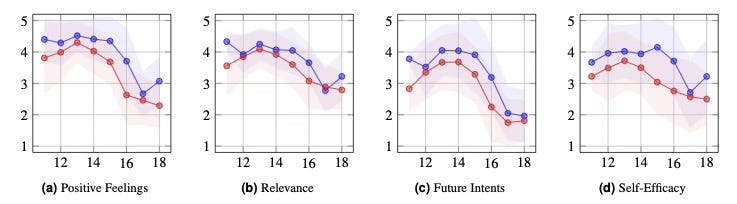
We looked at how more than 400 students, aged ten to eighteen, relate to computer science. What we found does not resemble a clean decline. Yes, attitudes fluctuate during adolescence. Yes, there is a noticeable dip in interest, confidence, and future intentions around mid-adolescence. But what changes is not whether students are capable or curious.
What changes is how they evaluate the subject and themselves in relation to it.
Underneath the surface variation, a stable core remained visible across age groups and genders: enjoyment of problem-solving, belief in one’s own ability, and the capacity to imagine a future connection to CS. That core does not disappear with age. What shifts is which parts of it carry the most weight.
Younger students tend to approach computer science as a broad, fascinating and playfull field. Their engagement is exploratory and generous. They are curious first and critical later. Older students become more selective. They ask tougher questions: Is this meaningful to me? Can I actually do this well? Does this fit who I’m becoming?Interest narrows, not because learners are weaker, but because they are more discerning.
The Adolescent Dip Isn’t A Loss of Ability
This transformation becomes especially visible during adolescence, a period shaped by identity formation, self-reflection, and social pressure. In our analysis, age mattered more than gender in shaping attitudes toward computer science. Both girls and boys showed rising interest up to early adolescence, followed by a marked dip between roughly fourteen and sixteen. That dip is often interpreted as disengagement. It isn’t. It’s a developmental transition.
Girls, Boys, and Timing
Gender differences did appear, but they were smaller than expected. The more striking pattern was timing. Girls’ self-efficacy began to decline earlier. Boys followed a couple of years later. This mirrors broader developmental research: adolescence reshapes confidence, identity, and perceived belonging, often earlier and more sharply for girls. The implication is not to “fix” girls or education for girls. It is to stop designing learning environments as if development didn’t exist.
What seems to be happening is not a loss of ability, but a shift in how students protect their emerging identity. Around mid-adolescence, learners become far more sensitive to signals of competence, belonging, and social comparison. Curiosity alone is no longer enough. Activities that once felt playful now carry reputational risk: being wrong feels public, being slow feels exposing, and being “into” something suddenly says something about who you are. For girls, this shift often arrives earlier, intersecting with earlier puberty and stronger stereotype pressure; for boys, it tends to surface later. In this phase, interest doesn’t disappear, it becomes conditional. Learners engage only where they feel safe enough, competent enough, and able to maintain a coherent sense of self. Interventions that ignore this reality misread withdrawal as apathy, when it is often a form of self-preservation. Once you see this, a lot of familiar patterns in CS education start to look different.
A Paradox: Older Students Change the Most
Here’s the finding that surprised even us. Despite reporting lower overall enthusiasm, older students showed the largest positive changes following short, well-designed computer science interventions. Their attitudes shifted more than those of younger students. Their resistance softened. Their future intentions became more open. Statements such as “I don’t want to deal with coding” weakened noticeably, while curiosity and willingness to re-engage reappeared.
This creates a paradox that standard educational narratives struggle to explain. Younger students enjoyed the courses more, but their underlying attitudes changed less. Older students were more critical, less easily impressed, yet more deeply affected.
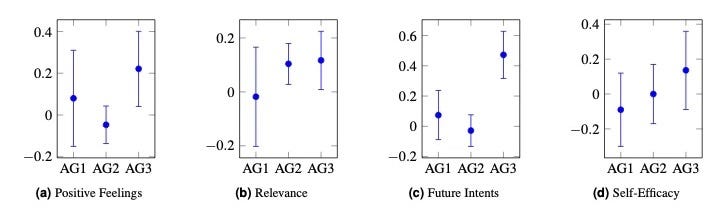
So yes, younger learners had more fun. But older learners were more transformed. This is the paradox most narratives fail to explain:
being harder to impress does not mean being unreachable.
Why Early Exposure Is Not Enough
Early exposure certainly matters. It shapes familiarity, confidence, and access. That part of the story is true. But it is not the whole story. Early exposure, it turns out, is not a guarantee. And late engagement is not a lost cause. Our findings suggest something subtler. Interest development is not front-loaded. It is reactivable.

Interest does not crystallise once and for all in childhood. It remains responsive, especially when learning environments meet learners where they are developmentally.
Enthusiasm Is a Moment and That’s Okay
One of the biggest mistakes is treating enthusiasm as a personality trait. Enthusiasm is not a trait. It is not a promise of a career. It is not something you either “have” or “lack.” It is a momentary activation, when positive emotion, perceived value, and willingness to continue align. Those moments fluctuate. They fade. They return.
Short interventions cannot manufacture lifelong interest. But they can keep pathways open that would otherwise close quietly.
This distinction matters because many educational systems implicitly expect enthusiasm to be permanent. When it fluctuates, as it naturally does during adolescence, it is interpreted as failure. Our findings suggest a different reading: fluctuation is not a sign that interest is gone; it is a sign that it is reorganising.
Designing for Attunement, Not Accumulation
If interest shifts with age, then learning systems must shift too. Not by adding more content. Not by pushing harder. Not by optimising dashboards. But by modulating support: clearer when the challenge rises, lighter when autonomy grows, being present without dominating. Interest doesn’t need to be engineered. It needs room to reorganise.
This is where the implications extend beyond computer science education. What we observed is not a need for more stimulation, more persuasion, or more aggressive encouragement. It is a need for attunement. Learning environments that recognise when learners require clarity and when they require space. When guidance should be present and when it should recede.
The older students in our study did not need louder signals. They needed environments that respected their developmental shift, where support adapted in intensity without disappearing, and where autonomy was not confused with abandonment. They respond less to novelty and more to meaning. Less to enthusiasm imposed from outside, more to confidence rebuilt from within.
Interest, in this sense, behaves less like fuel and more like structure. It responds to how learning is framed, not just to what is taught. It reorganises as learners mature, and systems that fail to reorganise alongside it will always misinterpret adolescence as disengagement. The lesson here is not that enthusiasm declines. It is that it becomes more selective.
Seen this way, the problem is not that students lose interest in computer science. The problem is that many learning environments fail to adapt as interest changes form. If educational systems continue to assume that interest should look the same at sixteen as it did at ten, they will keep designing interventions that arrive either too early or too bluntly. But if we accept that interest is developmental, responsive, and revisitable, a different design space opens up, one focused not on accumulation, but on timing.
This is why the early-start narrative, while well-intentioned, is incomplete. It assumes a linear accumulation of interest, when what we observe instead is a series of reconfigurations. Interest can weaken, strengthen, fragment, and return, sometimes more than once.
The Quiet Conclusion
The real problem is not that students lose interest in computer science. It’s that we misread what interest looks like as they grow up. We treat early enthusiasm as success and adolescent hesitation as failure, judging impact by enjoyment, while overlooking that for older students, the most meaningful changes often happen quietly.

Our findings suggest something uncomfortable: enjoyment and impact are not the same. Younger students may enjoy activities more, but older students are often the ones whose attitudes shift more deeply. They are harder to impress, but more capable of genuine reorientation when learning environments respect their developmental stage.
From this perspective, a dip in interest is not a warning sign but a developmental signal. Interest does not follow a straight line; it fragments, reorganizes, and, under the right conditions, returns. Adolescent disengagement is not a verdict—it is a request for relevance, autonomy, and dignity.
This way of thinking is also why
Thinkable exists. It grew out of the discomfort with designing learning as if interest must be captured once and then preserved. Thinkable is built on a different assumption: that thinking develops in phases, that curiosity changes form, and that meaningful engagement comes from environments that know when to step closer and when to step back.
If that view of learning resonates, you’ll probably feel at home there.
For more details read our research article Measuring Computer Science Enthusiasm: A Questionnaire-Based Analysis of Age and Gender Effects on Students’ Interest